Healthcare providers across the United States rely on accurate medical coding to receive timely reimbursements from insurance companies. Among the most important coding systems used in healthcare is CPT coding. Whether you are a physician, practice manager, medical biller, or healthcare administrator, understanding CPT codes is essential for maintaining a healthy revenue cycle.
In this guide, we’ll explain what CPT coding is, why it matters, and how it impacts medical billing and reimbursement in the U.S. healthcare system.
What Is CPT Coding?
CPT stands for Current Procedural Terminology, a standardized medical coding system developed and maintained by the American Medical Association (AMA).
CPT codes are used to describe medical, surgical, diagnostic, and healthcare services provided by physicians and healthcare professionals. These codes help insurance companies understand exactly what services were performed and determine the appropriate reimbursement.
Each CPT code consists of five numeric digits that represent a specific procedure or service.
For example:
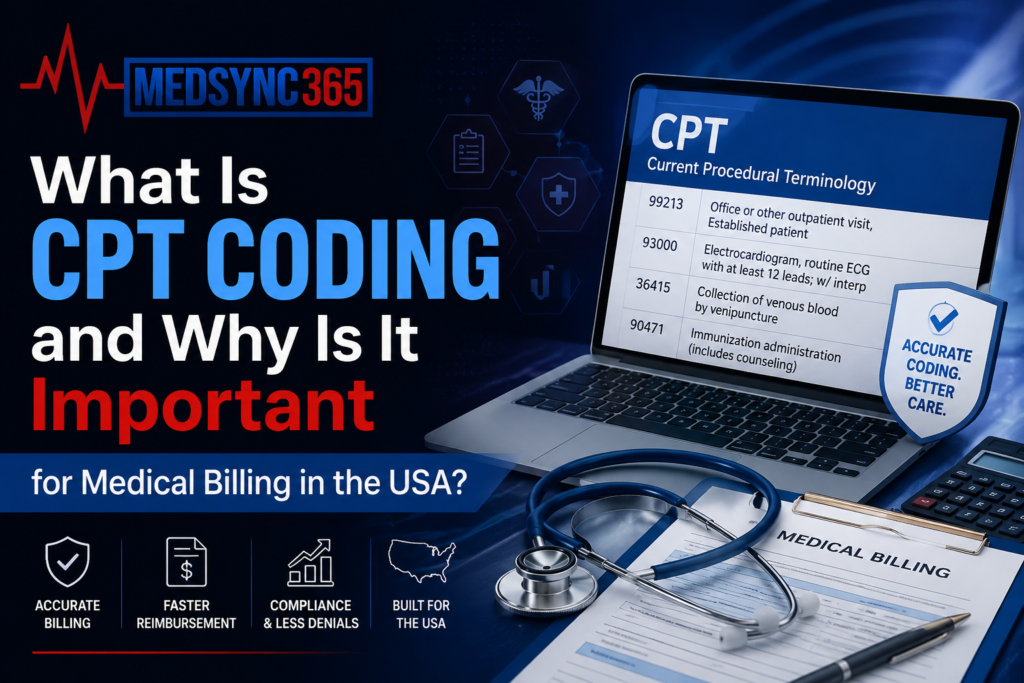
- 99213 – Established patient office visit
- 93000 – Electrocardiogram (ECG)
- 45378 – Diagnostic colonoscopy
Healthcare providers use these codes when submitting claims to Medicare, Medicaid, and commercial insurance payers.
Why Is CPT Coding Important?
CPT coding serves as the foundation of medical billing and reimbursement in the United States.
Without accurate CPT coding, healthcare providers may experience:
- Claim denials
- Delayed payments
- Reduced reimbursements
- Compliance risks
- Increased audits
Proper CPT coding ensures that healthcare organizations are compensated correctly for the services they provide.
How CPT Coding Works in Medical Billing
The medical billing process begins when a patient receives healthcare services.
After the visit:
- The provider documents the services performed.
- Medical coders review clinical documentation.
- Appropriate CPT codes are assigned.
- Claims are generated and submitted to insurance carriers.
- Insurance companies review the claim.
- Payment is issued based on the coded services.
Accurate coding helps prevent billing errors and improves the likelihood of first-pass claim acceptance.
Types of CPT Codes
CPT codes are organized into three categories.
Category I Codes
These are the most commonly used CPT codes and represent procedures and services routinely performed by healthcare providers.
Examples include:
- Office visits
- Surgical procedures
- Laboratory tests
- Radiology services
- Diagnostic exams
Category II Codes
These codes are used for performance measurement and quality reporting.
Examples include:
- Preventive care measures
- Patient safety reporting
- Chronic disease management tracking
Category III Codes
These temporary codes are assigned to emerging technologies, experimental procedures, and innovative medical services.
They help track the effectiveness of new treatments before they become standard practice.
CPT Codes vs ICD-10 Codes
Many healthcare professionals confuse CPT codes with ICD-10 codes, but they serve different purposes.
| CPT Codes | ICD-10 Codes |
|---|---|
| Describe procedures performed | Describe diagnoses and medical conditions |
| Used for billing services | Used to justify medical necessity |
| Developed by AMA | Developed by WHO and CMS |
| Five-digit numeric format | Alphanumeric format |
Both coding systems work together to support accurate claim submission and reimbursement.
Common CPT Coding Challenges
Healthcare providers often face several coding-related challenges.
Incomplete Documentation
Missing information can lead to incorrect code selection and claim denials.
Coding Errors
Incorrect CPT code assignments can result in payment delays and compliance concerns.
Upcoding and Downcoding
Using codes that inaccurately represent services performed may trigger audits and reimbursement issues.
Frequent Code Updates
The AMA updates CPT codes annually, requiring coders and billing teams to stay informed.
Benefits of Accurate CPT Coding
Proper CPT coding provides numerous benefits for healthcare organizations.
Improved Revenue Cycle Performance
Accurate claims result in faster reimbursements and fewer denials.
Better Compliance
Correct coding reduces audit risks and supports regulatory compliance.
Increased Reimbursement Accuracy
Providers receive appropriate compensation for the services delivered.
Reduced Administrative Burden
Fewer coding errors mean less time spent on claim corrections and appeals.
Enhanced Reporting
Accurate coding helps practices track productivity, performance, and financial health.
How CPT Coding Impacts Revenue Cycle Management
Revenue Cycle Management (RCM) depends heavily on accurate coding.
Errors at the coding stage can affect every part of the revenue cycle, including:
- Claims submission
- Payment posting
- Denial management
- Accounts receivable follow-up
- Financial reporting
Healthcare organizations that prioritize coding accuracy often experience:
- Higher collections
- Lower denial rates
- Improved cash flow
- Better financial performance
Best Practices for CPT Coding
Healthcare providers can improve coding accuracy by following these best practices:
- Maintain detailed clinical documentation.
- Conduct regular coding audits.
- Stay updated on annual CPT code changes.
- Train coding and billing staff continuously.
- Use certified medical coders.
- Implement coding compliance programs.
- Utilize advanced billing and coding software.
Why Healthcare Providers Outsource CPT Coding
Many practices partner with professional medical billing and coding companies to improve efficiency.
Outsourcing CPT coding can provide:
- Certified coding expertise
- Reduced staffing costs
- Improved claim accuracy
- Faster claim submission
- Better compliance management
- Increased reimbursements
This allows providers to focus more on patient care while specialists manage billing operations.
Conclusion
CPT coding plays a critical role in the U.S. healthcare reimbursement system. It ensures that healthcare providers accurately report services performed and receive proper compensation from insurance payers.
Accurate CPT coding improves claim acceptance rates, reduces denials, supports compliance, and strengthens overall revenue cycle performance. As healthcare regulations continue to evolve, maintaining coding accuracy remains one of the most important factors in achieving financial success.
Healthcare organizations that invest in proper CPT coding processes can improve operational efficiency, maximize reimbursements, and deliver a better experience for both patients and providers.
Need Help with Medical Billing and Coding?
MedSync365 provides comprehensive Medical Billing, Revenue Cycle Management (RCM), Coding Review, Denial Management, and Healthcare Growth Solutions for healthcare providers across the United States.
Contact our team today to learn how we can help optimize your billing performance and maximize reimbursements.